Friday, April 27, 2012

4/27: To Cappadoci

About 2 hours east of Konya is Sultan Han Caravansaray, one of the best examples of Anatolian Seljuk Empire architecture. 


 These Caravansarays were located about every 25 kilometers along the Silk Road, and used as a protected stop during the night for trade caravans. Their grandeur clearly stated the importance of trade for the Seljuk empire. 

 Located in the middle of the caravansaray was a small tower. It was a great space to stop and take a break.

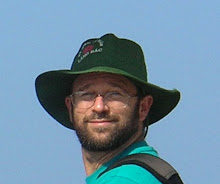
 Chaperone Doug and his new headgear. I don't believe he took it off all day long. 

Another hour to the northeast we entered the region of Cappadocia. 

                                             
Environmental and geographic conditions created spectacular scenery.  
                                           
                                             
The region is littered with cliffs and caves. Record of its history dates back to the 6th Century BCE. During the early Roman period when Christians were being hunted and killed, cliff cave were used as some of the earlier churches.  

                                             
We pulled the bus over at this first site, and, like wild animals penned to long, the students scurried up the hill. 


 I don't know what is more exciting than watching these students in the thrall of exploration and discovery. 

 Later we toured one of the many underground cities. These cities were dug out of the rock as hiding placed during the times of the Mongol invasion. This city was 8 levels deep, held up to 10,000 people, and could serve as a hiding space for up to 6 months. 


Dinner in Urgup

April 26th: Konya and Rumi


The mosques in Konya after sunset 4/25


4/26:
Morning Meditation on Sufism and the transcendent
I want you to think about a time of connection – when you felt a connection to another person, to an animal, to nature.
Or maybe it was about a place or a moment in time when you had the feeling of awe – an opening up to something more than you normally feel.

A student told me about a story she had read. A mother told her daughter about how we live our “normal” reality as if there is a veil over our eyes. But every once in a while, the veil is lifted, and we see everything differently. A moment of clarity or inspiration. But sometimes, the veil is lifted and we don’t recognize it. It could be said that the spiritual path is recognition when those moments of clear sight occur.

Who knows what inspires this. It could be a beautiful sunrise, or the words of a song.
For me, at times, it is the wind. Sometimes it feels like it blows right through me, and cleanses me, and all my worries and concerns disappear. Once, in the very early morning as I sat on my deck at my home, I heard the sounds of birds as I saw a star in the sky, and instantly my whole reality shifted. It was a transformative experience. We have all had these moments when the veil has lifted.

Every civilization, every people in the history of the world, has tried to explain this transformative experience.
Then it becomes “religion.”
And then the religious experience shifts to rules and regulations: cover your head, don’t eat pork, etc.
But there are always those who follow the mystical aspects of the religion – the deeper aspects that are about connection
It is a paradox, for it is about both the personal and the universal
A personal relationship to something more
Sufism is the mystical aspect of Islam – connecting to that which is greater or transcendent than the individual
You can call it God, or Allah, or the universal,
But it is always about experiencing the oneness of the universe

We have all experienced moments that are unexplainable –
When what you are about to say is said by another
Or, when looking at a plant or a sunset we feel a sense of expansion
Even science and physics are come to know is
How what we know of matter is mostly just empty space
Our connections go beyond the border of our body
Sometimes it happens at those moments when we are most vulnerable
When we let down our guard
When our hearts are touched by something or someone half a world away
We can all feel this connection
And every religion has practices which help us sense this
Sitting in meditation, or deep contemplation
In Sufism, it is whirling
A tool or method or letting go of self-identity
And allowing the little “I” to expand and feel the big “I” of oneness

After the guided meditation and a moment of silence to let their minds and hearts wander and see if they could feel the sense of connection, some students shared their thoughts. Then I challenged the students to try and remind themselves of this space throughout the day with the mantra, "Feel the connection."

After the meditation and sharing, some of the kids played Ultimate in the park, while a few of us were beckoned in to a building where there was a sewing coop - mothers, with their children in tow, were making bedspreads, pillow cases and baby quilts. 

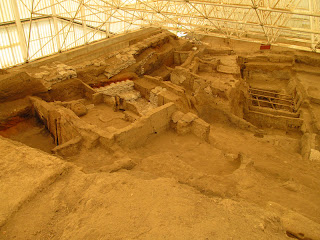
Catalhuyuk is the oldest city in the world. This densely packed neolithic settlement dates back over 9000 years. 

Excavations started in the 1960s. The settlement housed up to 10,000 people. There is no evidence that it was a fortress city, or that the settlement had any other reason for leaving together other than the desire of social life and to be near the burial site of their families, which was beneath each home. 


The artifacts found suggest that Catalhuyuk practiced a matriarchical system where "women were respected within an egalitarian society. The female figurines, reliefs, some paintings and symbols suggest beliefs and practices in which female divinity was honored."

Unfortunately, the tour of Catalhuyuk was not that interesting. There are archaeologists working there all summer long, which tourists can watch, but not much happening at this time. We headed back to Konya for lunch and exploring the old markets. 

Mosque in Konya

The old market


The students kept teasing me of all the shots I took of raisins. Unfortunately, none of the raison pictured turned out that well. 

Big containers lined up the the roof of some building

Another mosque

Mevlana Rumi's Mausoleum

This evening we watched a private performance of Whirling Dervishes. It was an amazing event, with music, prayer, and whirling, of course. 

After the performance, the lead Dervish stayed to answer questions. He explained about the rituals and what they mean. For example, the black robes they walked out in represented the soil, how we come from the earth and will return to the earth. The white robes underneath are just like the white cloth that the dead are wrapped in when buried. The shape of the hat represents a tombstone. I haven't talked to the students yet on their take on all of this symbolism about death. For me, I find the paradox fascinating - those cultures or practices that consciously focus on death and  letting go of the attachment often contain the most joyful people. 


We then met with the master in this really tiny room for another question and answer period (see picture above). My favorite quote from him was, "Whirling travels the person from the question, 'God, why am I here? to the statement, 'Thank you God for my being here.'"

Guru Eli and student Alicia

We ate dinner at the Rumi Center. We got a private room for all of us. It was a fantastic meal, and a bit playful as well. 

Wednesday, April 25, 2012

4/24 & 4/25: End of Antalya Stay

4/24:
Even though yesterday was great (the kids loved exploring the ruined city of Perge), it was a full day, which takes its toll on the kids. We had planned a full day tour again today, and decided to cancel it all. The students have a lot of assignments to do, and we needed to give the students time to work on them (daily digital journal, daily upload of best photos, and documentary project) as well. Their only requirement was to go to the Antalya museum, photograph their 5 favorite pieces, and record descriptions of the pieces. And instead of going as a huge group by bus to the museum, we decided to give them time options and go in small groups with an adult (somehow getting on the bus seems like a bit of an ordeal, but going in a small group and finding your way there feels like exploring). To our surprise, more then half the students chose the first option of the day - 8:30 AM departure, and only three students chose the latest option - 1 PM. So, it was a good lesson for the adults - we were projecting our own feelings onto the students. 

It turns out the students loved the museum as well. Many of them had a difficult time choosing their 5 favorite pieces, as did I. Here are my favorites:

The Three Graces, from Perge, 2nd Century CE
I really loved the gentle arms around each other.

 Scary face, from Arykanda, 2nd Century CE

 Hunting Artemis, from Perge, 2nd Century CE
For some reason I was attracted to the partial face.

 Woman lying down, lid of a sarcophagus, from Perge, 3rd Century CE
Again, it was the flow of the arms that attracted me.

 Dionysos Sarcophagus, from Perge, 3rd Century CE

 From the same sarcophagus as above, but details of the mother and child, which I loved.


 Gaius Caesar cenograph, from Limyra, 1st Century CE
I learned at the museum that a cenograph is a monument tomb-like structure raised in memory of rulers or heroes who died on the battlefield, at sea, or in a foreign country.
Gaius Caesar was the grandson of Augustus Caesar.

 Menorah plaque from the first synagogue in the Mediterranean region of Anatolia
4th or 5th Century CE

 Aphrodite holding a shield, from Perge, 2nd Century CE

 Pottery from Lekythos, 6th or 5th Century BCE
I liked the shape of this piece.

 Afterwards, I treated the students at the museum coffee shop, while I had Turkish coffee, and we talked about what Perge must have been like with so much public art everywhere. It was definitely the right order to see the ruins of Perge first. Then, when seeing the pieces in the museum the next day, and the majority of the museum pieces came from Perge, they had a context. 

That evening we went to Tansule's home for dinner. She invited all of us (5 students went out with pen pal families, so there were only 35 of us). We had to find our way on public transport, which was an adventure within the adventure.  

 It was a delicious vegetarian feast. 


 The students in Tansule's living room.

 Tansule's daughter and granddaughter, Billur and Nehir.

 Students eating on the balcony.

Meg, Sara, Lara and KJ (I think)

 Tansule's son, Safak, set up a Turkish disco in his bedroom. At one point I counted at least 20 people in there (all males). We were able to get Tansule and Alicia dancing, and then Billur taught us belly dancing, which chaperone Doug took to in a big way. 

On the bus ride back to our hotel, many of the students said it was the best night yet!

4/25: Leaving Antalya
It was really nice starting the first 8 days of the trip in Antalya. It felt good having a home base and an opportunity for the students to adjust to this new culture. It also feels good to leave. There is something about the process of leaving that is so seductive for me. I've had a fantasy all of my life to just start walking (a vagabond spirit, so to speak), and not turn back. I don't exactly know what that is about, but I feel it every time I leave. I puts me in a quiet, contemplative space. Maybe, in my mind, a holy space. Something about shedding all attachments. 

 We drove east along the coast, and then north through the Taurus Mountains, on our way to Konya, home of Mevlana Rumi and the Whirling Dervishes. 

 We stopped on the way at Tinaztepe, a 230 million year old cave. 

 This spectacular cave is 1580 meters long (almost exactly one mile).

 We also stopped at Esref Pasa mosque, which is 700 years old and made of wood.

 Meditation beads hanging in the mosque for use by anyone. In Islam there are 99 beads for the 99 names of Allah. I carry meditations beads with me, which I purchased at the Tibetan refugee capitol in India at McLeod Ganj. In Tibetan Buddhism, there are 108 beads for the 108 names of Buddha (I think).

We met the Imam of the Mosque, who sang for us the call to prayer. I love to hear the call to prayer, but it is so different hearing it live rather than blaring out of the mosque's loud speakers. 

Two of my students in the mosque