Sunday, April 25, 2010

4/25: fishing lesson

The students are divided into four groups, rotating through different lessons every morning: fishing, farming, bamboo lantern making, and cooking. No more bus while in Hoian - we ride our bikes through the country side each morning to our lessons.

On the bike ride to our fishing lesson

I took my eight students fishing. First we laid down long nets in the water, then slapped the water and made loud sounds to scare the fish into the nets. We also got the opportunity to practice throwing the individual, small net.

It was harder than it looked

The Vietnamese fishermen also have these nets attached to his huge structure, which they crank manually up and down.

The catch from one of the huge nets

This is my third year reuniting with my "Vietnamese wife," who requested I ride in her boat three years ago and subsequently have been teased about her ever since. This time she sang me love songs about her broken heart every time I leave. Last year my son Natan came with me to Vietnam, and she berated me for promising to send her a photo of the three of us together, which evidently I forgot to do. One thing I notice each time I go to the fishing lesson is how happy these people are. The life is very difficult, they make very little money, and they are always singing, laughing, and teasing each other (and me).

Bike ride to the ocean

Hoian is a little village about five kilometers from the ocean. In the afternoon the students can choose to ride to the beach, explore the town, or hang out at the pool. We met at 4PM to bike to the beach, and it turned out only one student was interested in returning there. So I asked the student, "If you end up being the only student, do you still want to go?" Without a moment's hesitation, he replied, "yes. Then I can meet Vietnamese people." I felt like crying.

Me, with Jack, Alfred, Josh (the first student) and Todd, a chaperone

It turned out that two other boys joined us, along with another chaperone, on the afternoon beach excursion.

Saturday, April 24, 2010

4/24: Denang and Hoian

View from Five Marble Mountain, outside Denang

We said goodbye to Saigon and caught an early flight to Denang. Unlike last year's trip, everything went so smoothly leaving the hotel, getting to the airport, checking in, the fight to Denang, retrieving our luggage, and then the bus to a restaurant in Denang. I remembered this restaurant from past years, and it was always one of my favorite "set meals," and I was not disappointed. The squid was so tender, maybe the most ever. The waitresses saw me checking out the other tables for uneaten squid, so they brought the extra to the "adult table."

After lunch, we drove to Five Marble Mountain. We had never visited it before, and I am so glad we stopped here this year. It will always be part of future itineraries. Besides very nice pagodas, there are three caves with incredible sculptures of Buddha or Kwan Yin, the Goddess of Mercy.

Kwan Yin

From Five Marble Mountain, the bus ride to Hoian was only 30 minutes. After checking into our hotel rooms, we rode bicycles to the beach, about six kilometers from Hoian.

I wanted to talk to the students in the evening about assumptions, so I lied to them about our hotel in Hoian, telling the group not to expect such nice hotels everywhere we go in Vietnam.

Hoian Hotel

They were all pleasantly surprised when they saw the Hoian Hotel, the nicest hotel we stay at in Vietnam (I figure the more I lie, the better I get at it, so I practice as much as I can).

Evening reflection and meditation:
"In the summer of 1988 I went to the island of Sumatra. I spent six hours on a jungle trek. The forest was so dense that it was too dark to take pictures. I heard animals, but because they are wild, they hid in the tree tops and I never saw them. At one point in the trek, we came out of the forest to the river. So after six hours in the jungle, I took only six pictures, and five of them were of the river.

I used to do an exercise with my students: after showing them my photos of the jungle trek, I would ask the students to describe the jungle of Sumatra. And then we would talk about the process of recording history, how everything we ever read is subjective, biased by the author due to his or her culture, gender, ethnicity, time period, selectivity of what the author chooses to write about, and by his or her limited understanding or experience.

Recently I realized that this is not only true for the recording of history, but also for what we hold to be true in our lives.

Everyone makes assumptions. It is part of human nature. We are thinking animals, learning from our experiences, and generalizing from a specific situation to something much larger - our concept of what is true. There is nothing wrong with making assumptions, as long as we are aware that that is what we are doing. We are trying to understand the world around us, learning from the experiences we have.

What assumptions did you have before you came to Vietnam?
What have you found, in your brief experience of four days, that you now understand is not true?
What assumptions are you now holding after your limited experience of four days?

Here is an assumptions I hold: the more you investigate these experiences, the more you will come to understand, not necessarily about Vietnam, her people or culture, but the more you will actually understand who you are. For as I told you before, everything you experience is an interaction between what is going on "out there" and what is going on "in here," in your mind and heart.

Here are three suggestions I have for what you might meditate upon:
1) How is Vietnam different form what you expected?
2) What assumptions are you holding about Vietnam, her people or culture?
3) What was a precious moment you had in Ho Chi Minh City?"

After a few minutes of silent meditation, the students wrote in their journals for about ten minutes, and then we went around in a circle, sharing one thing.

Excerpts from the student sharing:
"Going into the tunnels made the war real for me."
"When I entered the cave and saw the sculpture of Buddha, and all the people speaking in hushed voices, it felt as if I was entering something holy."
"If you reach out to someone else, you end up learning more about yourself."
"More important than having these assumptions was getting to understand that I have these assumptions, and that was something precious."
"On the outside, with all the poverty, it looks like there is such disappointment in people's lives, but in the inside there is such joy and contentment."
"Defining some actions as awkward keeps me from going outside of my own boundaries."

A number of students mentioned that they learned more about other people in their class in these few days than they had previously done in years. Many students describe little interactions they had with Vietnamese people, even without a common language, and how precious they were. So we talked about expanding their definition of what "common language" means, for all humans beings have a common language when "hearts touch."

Friday, April 23, 2010

4/23: Tunnels and Pagoda

Today we had a half day tour to the Cu Chi tunnels, about an hour and a half outside of Saigon, and then on to Vinh Nghiem Pagoda on the way back to Saigon. Students came back from their exploration in small groups yesterday a little overwhelmed by the heat, so we are just going to "hang out" this afternoon at the hotel.

The trip has gone very smoothly so far. We used to have our pen pal school visit in Saigon, but have shifted to a different school in Hanoi this year. Without the pen pal school in Saigon, the beginning of the trip has had a lot more down time and thus, has not been so exhausting for the kids while they are acclimatizing, which of course is the way it should be. We are flying to Hoian tomorrow morning.

Me with my dinner group last night

Our guide Mike with one student in front of a Jack fruit tree

Shirley, the other trip leader, going down into a tunnel at Cu Chi

All the students on a captured American tank (it is such an odd perspective to be exposed to, here at the Cu Chi tunnels: being an American and hearing all this information about how to defeat the American army or being shown models of traps, their sole purpose to injure or kill American soldiers - a lesson in seeing things through another person's eyes)

Incense offering at Vinh Nghiem Pagoda in Saigon

Buddhist monk laundry at the pagoda

More monk laundry

Thursday, April 22, 2010

4/22: War Remnants Museum

Banana Man

This morning we took the students to the War Remnants Museum, which basically documents the atrocities committed by the US military during the American War (we call it the Vietnam War, but the Vietnamese call it the American War), though to be fair, there is one room dedicated to Anti-American protests around the world, and another with "politically correct" pictures drawn by Vietnamese children concerning issues like peace and protecting the environment (my cynical side wonders how this school assignment came about in the communist controlled education system that doesn't even allow my students to meet with their pen pals, but that is a story for another day). It is a very intense experience for anyone, but especially for Americans. We had a very good discussion afterward, helping the students to debrief. Mike, one of our national guides, came up to me after the discussion and told me that the comments my students made helped him feel so good about the situation. I told him to share that sentiment with my students, which he did when we got back on the bus.

GI posing with the remnants of a Viet Cong soldier

Child drawing titled "My Homeland In Peace"

Child drawing titled "All Under The Same Roof"

I have been to this museum four times already, so when we got there, I just took a seat in the museum and watched the people. I saw many men a little older than me, and couldn't help but wonder if they were American Vets (I missed the draft by just a few years, being 14 years old when the US involvement in the American War ended). And if they are, what is going through their minds and through their hearts as they walk through this museum? Over the past four student trips to Vietnam, I have met a number of US Vets, and it always seemed like a healing experience coming back here.

And then I saw an old Vietnamese man, and who I assumed was his son taking pictures of him in front of displays of US munitions. The old man looked so serious. I assumed he was a veteran of this war. And as I was watching him, his face suddenly lit up into a huge smile. He was looking down at a little, blond child.

I introduced myself to the younger man. His father was a veteran of the American War. His family is from Hanoi. The son, who is 47 years old, has taken his father here for the first time. I asked him how it is for his father to see these images for the first time. He said, "My English is not good enough to answer that question." And then he said to me, "May I ask you, how old are you," which was his polite way of asking if I was an veteran of the American War.

It turns out the son, like his father, is also a veteran, but he was only 11 years old when the American War ended, though he does remember the "Christmas bombings" of Hanoi in 1972 (he was 10 years old at the time), when the US declared they would "bomb Hanoi back to the stone age." He was in the military for 12 years, and participated in the six-week border war with China in 1979, and the Vietnamese invasion of Cambodia, ending the "reign of terror" of Pol Pot and the Khmer Rouge. "But now we have peace," he said, and held out his hand to shake mine.

Me with two generations of Vietnamese veterans

Wednesday, April 21, 2010

4/20 & 4/21: Ho Chi Minh City (Saigon) and the Mekong Delta

4/20:
On the way to the airport with my national guides, Mike and Ha, the conversation came around to shopping. I told them that Christy hasn't asked for anything on this trip to Vietnam yet. "Maybe she has everything she needs," I suggested. "Never think like that," Ha replied. "For women, never enough. Always more."

After picking up the Evergreen school group at the airport, and checking into our hotel, I asked the students if anyone was too tired to do a little exploring in small groups. Everyone was up for the adventure.

My small group of students with a bicycle rickshaw man

I knew the students were running on adrenalin, and by dinner time there would be nothing left but fumes, so we planned an early dinner - 5:30PM. By 7PM they were falling asleep at the table. There was no need for a bed time or a room check this night.

The Mekong Delta

4/21:
It was a full day tour to the Mekong delta today. We started out on a big boat, supplied with fresh coconuts, rambutan, and rose apples. After a tour of the floating market, we went through little water ways in boats for three people, and then we went to a shop/food factory and saw a number of demonstrations: how to make coconut caramels, how to pop rice in a huge wok using really hot black sand, and how to make sweet rice treats. We then had a delicious meal with huge prawns (I tried to convince the students that it wasn't safe to eat them, and I would make sure they were disposed of properly, which no one bought), elephant ear fish wrapped in rice paper with mint, pineapple, star fruit, and cucumber dipped in fish sauce (also delicious), corn and bean soup, and fresh fruit. This was followed by a sampling of many delicious fruits: jack fruit, pomelo, papaya, and pineapple.

Man on a boat

In the floating market, we stopped a pineapple boat and got fresh pineapples for everyone. One student said this was the best pineapple he had ever tasted.

Me with the "pineapple" lady

On top of the "pineapple boat"

The students have had a "trip advisory" class once a week, where all kinds of topics related to the Vietnam trip are discussed. They have had a couple of meditation teachers throughout the year, and I use that experience to do guided meditations with the students while in Vietnam.

First guided meditation:
This moment is precious
Every moment is precious
For every moment is an opportunity
We have had a day and a half of "experiencing Vietnam"
And maybe we think that what is happening is that we are experiencing what is "out there"
But everything we are experiencing is in our heads
For there are two trips occurring simultaneously
One is external - what our five senses are sensing
But there is always an interaction between what is happening "out there" and what is happening in our heads
And that is the second trip - the internal one
Every moment is precious because every moment is an opportunity to learn
But what we are really learning about is who we are by the way in which we interact with the world

After a silent meditation for a few minutes, I discussed with the kids about the tendency, when in uncomfortable or unfamiliar situations, to protect yourself through insulation, which could be surrounding yourself with your friends, wanting familiar foods, or watching TV. But the more you can become "vulnerable" by exposing yourself to the experiences of Vietnam, the more complete your experience.

Laundry on the Mekong delta

More laundry on the Mekong

Monday, April 19, 2010

4/19: Vietnam

Reunion with my tour guides Mike and Ha at the airport. Mike has been our guide for the past three Evergreen trips to Vietnam, and Ha for the past four trips, so it was very nice to see my old friends again.

Dinner on the street, along with Mike's friend Anh. I got a haircut today, and the haircutter didn't quite understand about trimming my beard.

Sunday, April 18, 2010

4/19: Leaving Malaysia

Me with some teachers and administrators at Seri Puteri, after the Monday morning assembly

I fly to Vietnam today to meet my students for a 25 day trip throughout the country. I have spent the last two days back at Seri Puteri, in Cyberjaya near Kuala Lumpur. I asked the principal if I could say good bye to all the students at the Monday morning assembly. I told her I only needed 30 seconds. She said, "You have five minutes. Say more." The kindness and generosity of the teachers, administrators and students at this school have touched my heart, so I want to share what I said at the assembly.

"I leave today for Vietnam to meet my students. I have had a wonderful month in Malaysia and am very sad to leave, but I am also very excited to see my students again, for I have been away from the United States for eight months. Even though I am on a one year leave from my school, I couldn't give up the part of my job to lead the Global Studies trips abroad. And I want to explain why.

When you travel, there are two journeys occurring at once. One is the external journey - seeing different places, people and cultures. The other journey, and the more important one, is the internal journey. And this is what I really want to talk about. When you live with an open heart, you cannot help but grow from your experiences. As you experience different places, and interact with different people and cultures, all the changes can either shut you down or open you up. For we experience with both our minds and our hearts. Your mind is constantly analyzing, comparing and judging, which creates separation. But our heart is only loving and accepting. If you can suspend the actions of the mind for a little while, and experience with your heart, then what you experience is connection. It is my hope that I can help my students to open their eyes and their hearts to the world around them. And when this happens, then it touches my heart.

My experience at Seri Puteri touched my heart. The teachers and students have been so welcoming. Your open hearts have been a special gift to me. So I want to thank all of you for opening your hearts to me. "

Breakfast with the English teachers after the Monday morning assembly

My three special students, Nadz, Nuzac and Kelly, who I first met at Modern School in India

Friday, April 16, 2010

4/15 and 4/16: Cameron Highlands

Hill View Inn, where I am staying. Cameron Highlands has a lot of British architecture. It is a very developed tourist destination. You can even get scones and jam for breakfast, if you want. But there is also good Indian food, so I am sticking with my roti telor.

Yesterday I went searching for the beginning of the jungle path to the water fall. After getting lost for an hour, I finally found it. I came across a man on the path, his back to me peeing. So we became friends. His name is Simpson, from Great Britain, though he lived in Australia for 40 years, and has now lived in Cameron Highlands for 12 years. He is 76 years old, and recently remarried to a woman from Sumatra. Besides children and grandchildren from his first married, he now has a new three year old girl.

We walked and talked together for one and a half hours, and to this beautiful evening view.

Today I went to Sungai Palas Boh Tea Estates. There is something so attractive about the tea plants, which seem to carpet the hillsides.


Laundry and tea plants

Tomorrow I head back to KL and Seri Puteri School for my last two days in Malaysia. On Monday I will fly to Vietnam, arriving there a day before my students.

Thursday, April 15, 2010

4/9 through 4/14 on Perhentian Island

I am back in the land of internet, in Cameron Highlands, after six days on the beautiful islands of Perhentian Besar (big) and Perhentian Kecil (small), but my story actually starts the day before I arrived.

4/8:
I took a early morning bus from Cherating to Kuala Terrengganu, arriving around noon. While I was checking into my hotel, I realized my legs really itched. It turned out I was attacked the night before by bed bugs, counting 60 bites on my two legs (I've always liked to count). It's a little funny, if you can call it that, because it was the third night I was in Cherating.

4/9:
I met a very nice man named Yann, from France, on the boat from the mainland to Pulau Perhentian Besar. Since he had a guide book, and didn't mind me tagging along, I followed him. We found a couple of nice bungalows about 20 meters from the beach. They were a bit beyond my budget at $19 a day, but I'm on a beautiful island 20 meters from the beach!

Pulau Perhentian Besar (meaning: Big Perhentian Island)

It turns out there are no roads on either island, and very few foot paths. It is mostly jungle, some beaches, and a few spots where bungalows or nicer accommodations are built. I decided to go for a walk to the other beach, about 25 minutes through the jungle. I was on the path no longer than 30 seconds when an alligator crawled out of the jungle. It looked like an alligator - it was at least 6 feet long. It actually more closely resembled a Komodo dragon. I ran to get Yann, who told me it was only a monitor lizard, and was harmless. Yea, right.

My bungalow on Pulau Perhentian Besar

More on Islam:
Chapter 112 is considered the essence of the Qur'an: "God is one, the eternal God. He begot none, nor was he begotten. None is equal to him."

The Hadith
(the second most important book in Islam):
During the life of the Prophet, there was no regular compilation of his life and acts, though many of his companions wrote collections of the words of the Prophet. There were some records kept by the companions, and many of the companions memorized the Prophet's words and actions, and passed these on through their oral traditions. After Mohammad's death, especially with the spread of Islam and the gradual passing away of the companions, centers of learning were created to preserve their history and practices, and to teach the new converts, though these were individual compilations (the second period of compilation). It was not until the period of the disciples of the companions (the third period - 100 to 200 years after Mohammad's revelation) that regular compilations occurred. Islamic law started during this time period. The "golden age" of the Hadith occurred during the 4th period of compilations (200 to 300 years after Mohammad's revelation), the disciples of the disciples, when actual rules were framed and canons devised.


Quote from Brida, by Paulo Coelho
:
"Sometimes, certain of God's blessings arrive by shattering all the windows." (p. 114) I really like this quote, for often, those events that feel so bad end up being your best teachers.

4/10:
I rented a mask and snorkel the day before, but was pretty unimpressed with the coral to the right, so at sunrise, I headed to the left. First I disturbed a string ray buried in the sand. Then I saw a shark. It was only a reef shark, and I was told that they are harmless, but it was still three to four feet long! So that was my initiation into "shark world."

Laundry and beach soccer at sunset

Two lines from a poem by W. B. Yeats, in Brida, by Paulo Coelho:
"I have spread my dreams under your feet;
Tread softly because you tread on my dreams." (p. 176)

4/11:
I moved to Pulau Perhentian Kecil (the small island). I am staying on Coral Bay. I found a bungalow for $13 a night. It is not as nice as my previous bungalow, but it is right on the beach facing the ocean, and I like the atmosphere here much more - no resorts, more of a back packer crowd.

Pulau Perhentian Kecil (Small Perhentian Island)

View from the porch of my bungalow on the small island

Jesse, my next door neighbor

I was at my new bungalow for about 10 minutes when I met Jesse, my next door neighbor. She was going on an all-day snorkeling trip, and invited me along.

Snorkeling trip my first day on the small island, and a little map of the islands

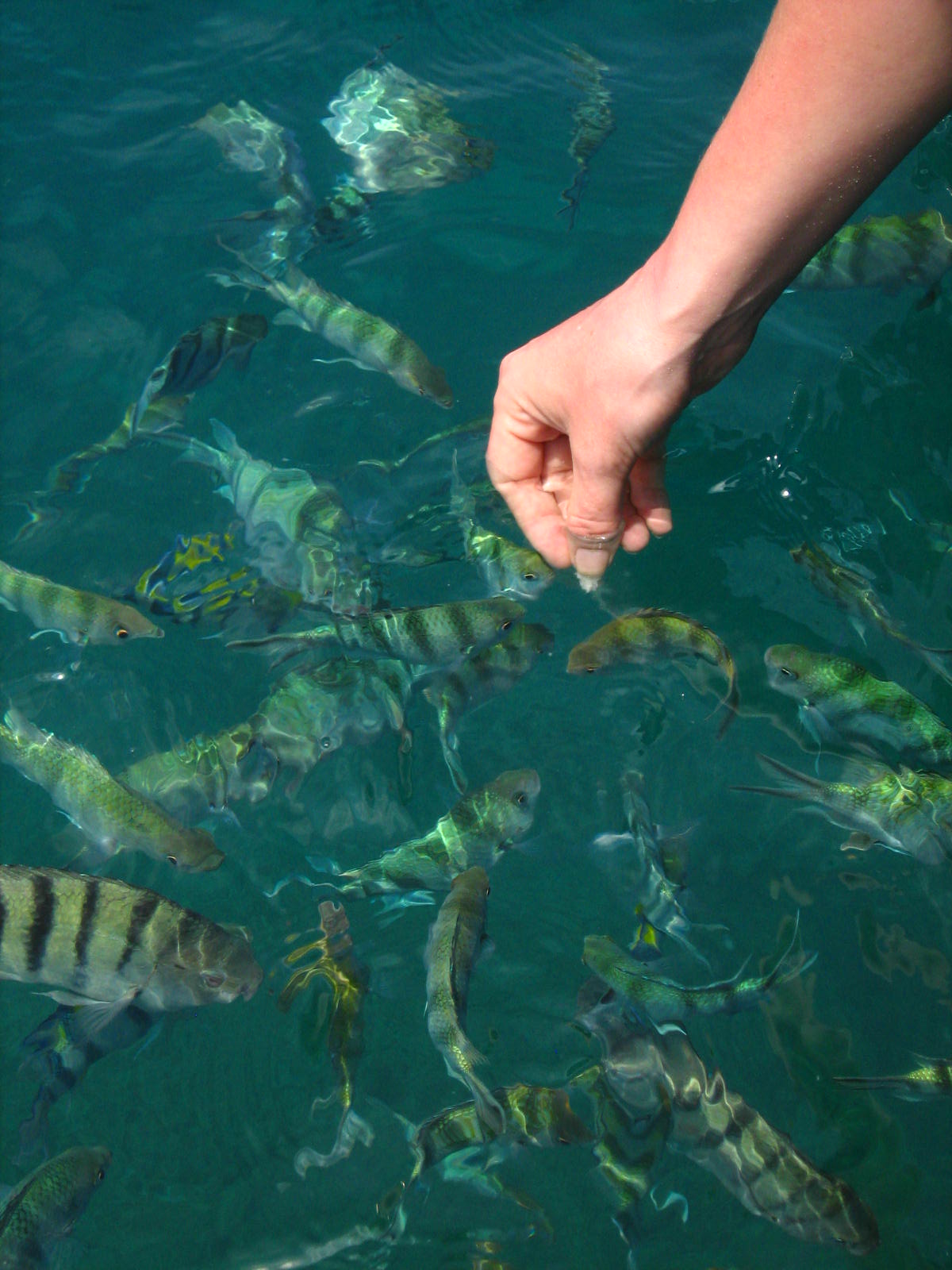
There were eight of us on the boat: 4 Malaysians, 2 from Great Britain (Daniel and Amelia, or maybe Angela - something starting with "A"), Jesse and me. We went to five different snorkeling locations. The first spot was "shark reef," where we saw three sharks (two very large ones, or one very large one twice), one sting ray, and some very spectacular coral. I also found a mask and snorkel in the coral (a good sign). The sharks may have freaked out the Malaysians, for they never got back into the water, and went back early. The second location was equally beautiful, with millions of fish that will eat bread right out of your hand. Then on to "turtle spot," where I saw no turtles (but the English couple saw two), then lunch, the lighthouse (I counted a school of 80 barracudas - I like to count), and lastly, "Romantic Bay." It was an incredible day.

Feeding the fish

Quote from Brida, by Paulo Coelho:
This was advice from a a spiritual teacher as Brida was judging another: "Play your part and don't worry about what others do. Believe that God also speaks to them, and that they are as engaged as you are in discovering the meaning of life." (p. 187)

4/12:
I LOVE SNORKELING! 2 reasons: 1) It is spectacularly beautiful with the variety and density of fish and coral, and 2) It is the only cool place in this really hot environment.

Today I went snorkeling four times, spending five hours in the water. On my third swim I saw a huge grouper (I read they can get up to nine feet long and 1300 pounds!). And on my last swim of the day at sunset, I saw a small shark, then a large shark, then a really large turtle. The fish don't seem to be bothered by us humans. You can go right up to them and swim with them. I guess that is a good sign that there haven't been human predators for a while (or a bad sign that they are really dumb animals).

This is where I ate most of my meals - Mama's Cafe.

View while eating breakfast from Mama's

Sufism:
The word is derived from either the word "safa," meaning purity, or "shabus-safa," meaning people of the bench (There were Muslims at the time of Mohammad who spent all of their time in worship, and would sit on the benches of the porch of Mohammad's mosque. The Prophet fed them and commanded his companions to do the same.), or from the word "suf," meaning wool (wearing woolen garments by ascetics was a sign of voluntary poverty and renunciation of the world and all of it's pleasures). (p. 126)

The Prophet is said to have received a two-fold revelation - one embodied the contents of the Qur'an, the other within his heart. The Sufism of these early Muslims was characterized by renunciation of all worldly pleasures and and intense fear of Allah and the day of judgments. The early Sufis were strict ascetics, with poverty as the ideal of their religious life. (p. 126-7)

The Sufis believed in "Wahadatul wajud," the oneness of existence. The human soul is a particle of the divine soul. Love for God is true love, while all other love is illusory. Material substance are just like pictures, leaving no real existence. Thus, they believed, we should only attach ourselves to God. (p. 128)

Quote from Brida, by Paulo Coelho:
"Being human means having doubts and yet still continuing on your path." (p. 236)

4/13:
I learned about sea lice today. I first experienced them while snorkeling in Flores. I felt all this stinging on my body, but thought it must be salt water in my pours. Jesse explained to me today that it is sea lice. They don't leave any lasting effect, they are just annoying. It seems they are worse in the early morning. I went snorkeling three times today, all to the right (I'd seen enough sharks to the left). On my afternoon swim, I took a deeper sea route on the way out, then hugged the shore on the way back. That way I see more, and if I get tired on the way back, at least I am close to shore to stop and rest. Also, I like swimming in all the little nooks and crannies. I was in one of these very shallow inlets when a shark swam by. There was no way out, so he (I assume he was a "he") had to turn around and swim by me again. I didn't take my eyes off him (or her) for a long time. I swam back a little faster than usual.

More on Islam - Children's Duty to Parents:
"Once a companion of the Prophet asked him to whom he should show kindness. The Prophet replied, 'Your mother.' He asked who came next and the Prophet again replied, 'Your mother.' He asked the Prophet yet again who came next. The Prophet replied, 'Your mother." When he asked for a fourth time, only then did the Prophet reply, 'your father.'" (p. 141)

(This is sort of like the "location, location, location" story)

Quote from Brida, by Paulo Coelho:
"The first road to God is prayer, the second is joy." (p. 252)

4/14:
Jesse and I rented a two-person kayak today, and went out for a couple of hours, hitting three beaches for some very nice snorkeling.

At 6:30PM I went out for my last snorkel, to my favorite spot on the left. Just when I got to "magical mushroom land," where the coral resemble huge mushrooms as big as small hills, a medium size shark passed me by on my right. Then ten seconds later a large momma shark with her little shark cub passed me by on the left. I thought, "this is as good a sign as any to turn around." I swam back quickly, swimming next to the underwater cliff wall near the shore, when a fourth shark passed me. A few minutes later a fifth shark passed me, circle around me, and passed again. Now I am pretty freaked. I kept saying to myself, "These are reef sharks. They are harmless."

I have always been freaked out by sharks, ever since I saw the movie "Jaws." I'm not even that comfortable in lakes (as soon as it would get quiet, I would hear that background music from the movie). So I have to ask myself, why did I keep going back into the water, and swimming alone. I don't really have an answer, though I know it is my nature to never give up. I'm a little compulsive about that. Maybe it's something about confronting my fears. Or maybe it's a little pride thing: no fucking shark is going to keep me from doing my new found passion.

Every evening Jesse and I would eat barbecue - choice of shark, lobster, squid, or mackerel (I should have eaten more shark).

Jesse (from Australia) and me

Sunset the last evening on the small island

Maybe the last on Islam (at least from this book), concerning neighbors:
"Nobody can be a believer, said the Prophet, if his neighbors pass the night hungry while he has his stomach full." (p. 144)

Quote from Brida, by Paulo Coelho:
"Everyone, at least once in east incarnation, possesses the secret of the universe." (p. 273)